Tempeh
Indonesian fermented soy product with a firm bite
What is this ingredient?
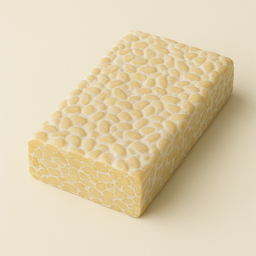
Tempeh has been a recognizable part of Indonesian cuisine, especially on Java, for more than 400 years. Unlike tofu, which is made from coagulated soy milk, tempeh consists of whole soybeans fermented into a compact cake by Rhizopus oligosporus. The white fungal threads, known as mycelium, form a firm network that binds the beans together and gives tempeh its characteristic bite.
During fermentation, flavour, texture and composition change. Rhizopus enzymes break down part of the phytate and trypsin inhibitors that naturally occur in soybeans. This gives tempeh a milder, nutty flavour and a different food matrix from unfermented soybeans. Per 100 g, tempeh contains about 19 g protein, 7 g fibre and little sodium, making it a nutrient-dense base for plant-based meals.
In the kitchen, tempeh is highly versatile. You can steam it to soften bitterness, slice it thinly and fry it until crisp, or marinate cubes with kecap manis, garlic, ginger, sambal and sesame oil. In Indonesia, tempeh is often fried, deep-fried, stir-fried or served with peanut sauce. Its firm structure absorbs marinades slowly and holds up well in bowls, curries, sandwiches and rice dishes.
When buying tempeh, look for a fresh, nutty smell and an even white layer around the beans. Small black specks are usually normal sporulation of the fermentation culture. A strong ammonia smell, slimy texture or unusual discoloration is a sign not to use the product.
How does it taste?
Nutty and slightly mushroom-like with a firm, fermented bite.
Pairs well with:
Pairs well with soy saucegarlicsambalpeanuts and rice.
Varieties
Soy Tempeh
Classic whole-soybean version, firm in texture and rich in protein.
Tempeh Mendoan
Thin slices in seasoned batter, briefly fried until the outside is softly crisp.
Tempeh Gembus
Made from okara, the fibre-rich pulp left after soy milk production; softer and milder.
Did you know...?
- Tempeh originates from Java, Indonesia, and has been eaten there for centuries.
- The white layer around tempeh is Rhizopus oligosporus; it holds the beans together in a compact cake.
Nutritional Value & Energy
Per 100g
Tempeh provides energy thanks to natural nutrients , buffered by fiber.
Per 100g
Minerals
Vitamins
More nutrients
Trace Minerals
What's in a serving?
1 serving
Tempeh naturally contains magnesium (81 mg per 100 g).
Tempeh naturally contains iron (2.7 mg per 100 g).
Tempeh naturally contains potassium (412 mg per 100 g).
Tempeh naturally contains selenium (8.8 mcg per 100 g).
% of daily reference intake (DRI)
EU-approved nutrition claims
This ingredient contains nutrients for which EFSA-authorized health claims exist (at nutrient level, not ingredient-specific).
Approved health claims (EU)
Magnesium EU 432/2012
Magnesium contributes to normal muscle function
Contains 81mg/100g (threshold: ≥56.25mg/100g)
Magnesium EU 432/2012
Magnesium contributes to the reduction of tiredness and fatigue
Contains 81mg/100g (threshold: ≥56.25mg/100g)
Magnesium EU 432/2012
Magnesium contributes to normal functioning of the nervous system
Contains 81mg/100g (threshold: ≥56.25mg/100g)
Iron EU 432/2012
Iron contributes to normal energy-yielding metabolism
Contains 2.7mg/100g (threshold: ≥2.1mg/100g)
Iron EU 432/2012
Iron contributes to the reduction of tiredness and fatigue
Contains 2.7mg/100g (threshold: ≥2.1mg/100g)
Potassium EU 432/2012
Potassium contributes to the maintenance of normal blood pressure
Contains 412mg/100g (threshold: ≥300mg/100g)
Magnesium EU 432/2012
Magnesium contributes to normal energy-yielding metabolism
Contains 81mg/100g (threshold: ≥56.25mg/100g)
Magnesium EU 432/2012
Magnesium contributes to electrolyte balance
Contains 81mg/100g (threshold: ≥56.25mg/100g)
Magnesium EU 432/2012
Magnesium contributes to normal protein synthesis
Contains 81mg/100g (threshold: ≥56.25mg/100g)
Magnesium EU 432/2012
Magnesium contributes to normal psychological function
Contains 81mg/100g (threshold: ≥56.25mg/100g)
Magnesium EU 432/2012
Magnesium contributes to the maintenance of normal bones
Contains 81mg/100g (threshold: ≥56.25mg/100g)
Magnesium EU 432/2012
Magnesium contributes to the maintenance of normal teeth
Contains 81mg/100g (threshold: ≥56.25mg/100g)
Magnesium EU 432/2012
Magnesium has a role in the process of cell division
Contains 81mg/100g (threshold: ≥56.25mg/100g)
Iron EU 432/2012
Iron contributes to normal cognitive function
Contains 2.7mg/100g (threshold: ≥2.1mg/100g)
Iron EU 432/2012
Iron contributes to normal formation of red blood cells and haemoglobin
Contains 2.7mg/100g (threshold: ≥2.1mg/100g)
Iron EU 432/2012
Iron contributes to normal oxygen transport in the body
Contains 2.7mg/100g (threshold: ≥2.1mg/100g)
Iron EU 432/2012
Iron contributes to the normal function of the immune system
Contains 2.7mg/100g (threshold: ≥2.1mg/100g)
Iron EU 432/2012
Iron has a role in the process of cell division
Contains 2.7mg/100g (threshold: ≥2.1mg/100g)
Selenium EU 432/2012
Selenium contributes to the maintenance of normal hair
Contains 8.8mcg/100g (threshold: ≥8.25mcg/100g)
Selenium EU 432/2012
Selenium contributes to the maintenance of normal nails
Contains 8.8mcg/100g (threshold: ≥8.25mcg/100g)
Selenium EU 432/2012
Selenium contributes to the normal function of the immune system
Contains 8.8mcg/100g (threshold: ≥8.25mcg/100g)
Selenium EU 432/2012
Selenium contributes to normal thyroid function
Contains 8.8mcg/100g (threshold: ≥8.25mcg/100g)
Selenium EU 432/2012
Selenium contributes to normal spermatogenesis
Contains 8.8mcg/100g (threshold: ≥8.25mcg/100g)
Selenium EU 432/2012
Selenium contributes to the protection of cells from oxidative stress
Contains 8.8mcg/100g (threshold: ≥8.25mcg/100g)
Potassium EU 432/2012
Potassium contributes to normal functioning of the nervous system
Contains 412mg/100g (threshold: ≥300mg/100g)
Potassium EU 432/2012
Potassium contributes to normal muscle function
Contains 412mg/100g (threshold: ≥300mg/100g)
What's being researched?
Tempeh and protein digestibility
Fermentation by Rhizopus is studied in relation to protein digestibility and changes in the soy matrix. Research also describes differences in mineral availability between tempeh and unfermented soy.
Supported by: [2] Harahap IA (2026) , [1] Feng XM (2007) , [3] Rekha CR (2010)
Tempeh and soy isoflavones
Tempeh is studied as a fermented soy source with isoflavones and fibre. Clinical and nutritional studies mainly examine differences between fermented and unfermented soy.
Supported by: [1] Feng XM (2007) , [3] Rekha CR (2010)
Good Combinations (Synergy)
Combine tempeh smartly to enhance the effect:
Tempeh  Spring Onion
 Allicin improves iron absorption from plant sources
Technical: Tofu contains 5.4mg non-heme iron per 100g, but also phytate (inositol hexaphosphate) that binds iron. Green onion's sulfur compounds (allyl sulfides) reduce phytate binding through pH lowering in the gut. Vitamin C in green onion (18.8mg/100g) reduces Fe³⁺ to Fe²⁺ for better absorption via DMT-1 transport proteins.
What does this mean for you? Always garnish tofu with green onion — the sulfur compounds free iron that would otherwise remain bound to phytate. Essential for vegetarians and vegans relying on plant-based iron.
Tempeh  Ginger
 Protein digestion + bioactive gingerols
Technical: Tempeh's Rhizopus oligosporus mycelium has already started protein breakdown during fermentation — proteins are partially hydrolyzed and more digestible. Ginger's gingerols speed up gastric emptying by ~25%. Together they optimize protein digestion: tempeh makes protein 'pre-digested', ginger accelerates further breakdown.
What does this mean for you? Fry tempeh with fresh ginger and tamari — a classic Indonesian preparation. The ginger not only helps flavor-wise but also ensures you maximize protein utilization from tempeh. Ideal after exercise.
Tempeh  Turmeric
 Fermentation + curcumin: fermented isoflavones with enhanced absorption
Technical: Tempeh contains fermented isoflavones (genistein, daidzein) with higher bioavailability than in tofu. Turmeric's curcumin is fat-soluble and better absorbed through the fats in tempeh. Both compounds are studied in research on NF-κB signaling and cellular mechanisms.
What does this mean for you? Fry tempeh in coconut oil with turmeric and black pepper. A classic Indonesian preparation that also provides complete protein. Black pepper increases curcumin absorption by 2000%.
Tempeh 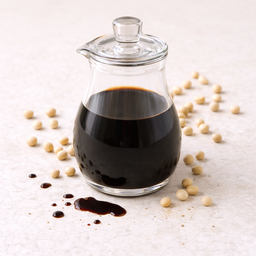 Soy Sauce
 Double fermented: complete umami + enhanced isoflavone absorption
Technical: Tempeh and soy sauce are both fermented from soybeans but through different processes. Tempeh contains Rhizopus oligosporus, soy sauce Aspergillus. Together they provide: complete amino acid profile, umami (glutamate from soy sauce enhances flavor), and increased isoflavone bioavailability through fermentation.
What does this mean for you? Marinate tempeh in soy sauce with ginger and garlic, then fry. This is the standard Indonesian preparation method.
Recipes with Tempeh
Discover delicious recipes featuring tempeh:
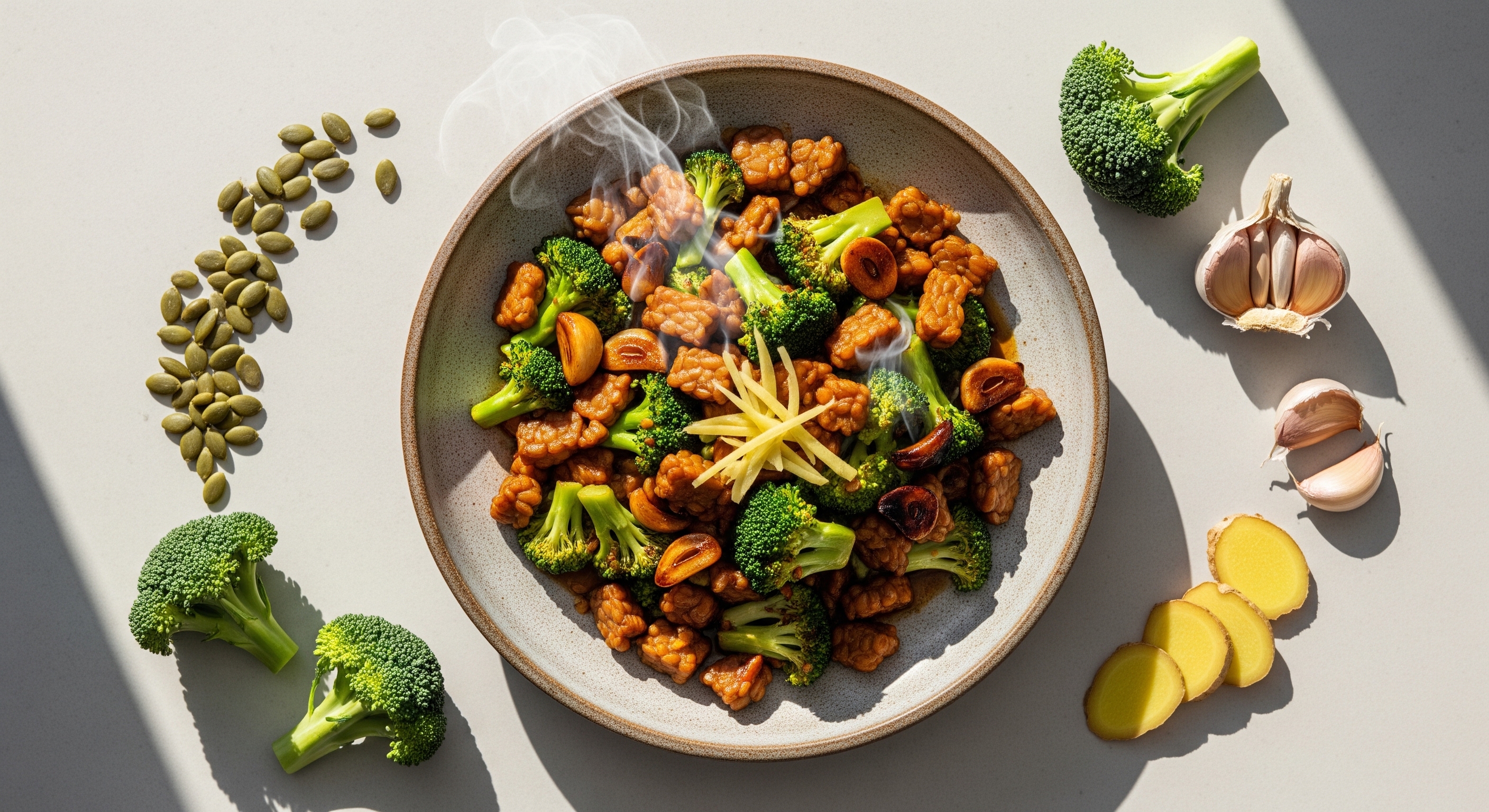 Broccoli Tempeh Stir-Fry with Sesame 30 min Savory, nutty and crisp from the wok
  365 kcal
  26g protein 2 synergies
  Indonesian Gado-Gado with Peanut Sauce & Tempeh 35 min Indonesian salad with fried tempeh, vegetables, egg and creamy peanut sauce 742 kcal 34g protein 2 synergies
 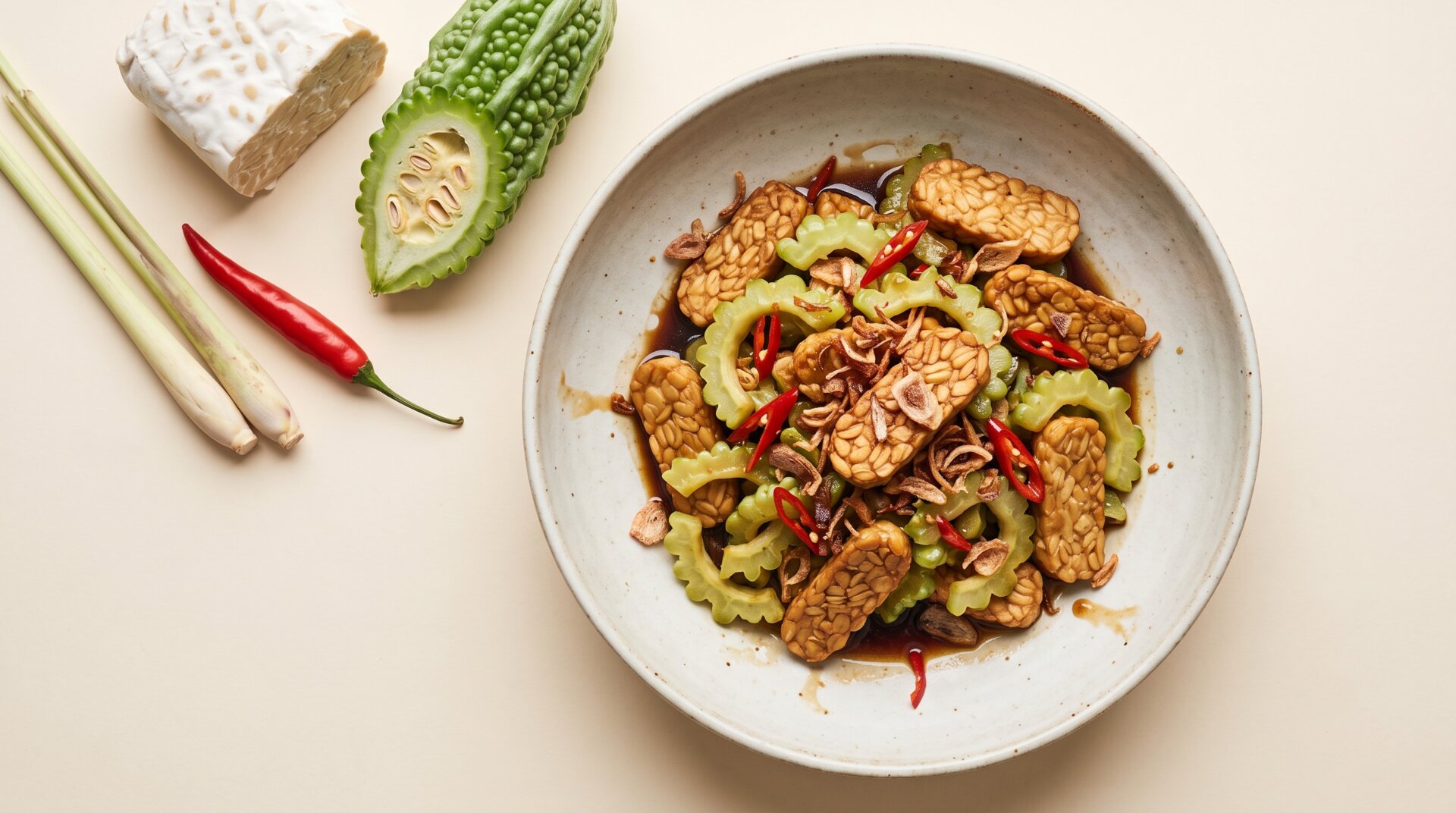 Indonesian Tempeh with Bitter Melon 45 min Stir-fry with kecap manis, galangal and lemongrass 320 kcal 18g protein 2 synergies
  Crispy Tempeh Kale Bowl 35 min Savory, smoky and full of bite with tamari tempeh 520 kcal 28g protein 2 synergies
  Quinoa Tempeh Salad with Tahini 35 min Complete plant proteins in one bowl 540 kcal 28g protein 2 synergies
  Tempeh Broccoli Stir-Fry 35 min Crispy tempeh with broccoli, bell pepper and sesame seeds from the wok 450 kcal 22g protein 2 synergies
  In the Kitchen
Storage
Location:Refrigerator
Shelf life:1 week in koelkast, 3 maanden in vriezer
Fresh tempeh may have an even white mold layer; that is part of the fermentation. Black specks are often normal sporulation. Avoid tempeh with an ammonia smell, slimy texture or unusual discoloration.
Preparation
Slice or cube and fry, grill or stir-fry until the edges are crisp. Steaming makes the flavour milder and helps marinades spread more evenly. Combine with kecap manis, garlic, ginger, sambal, peanut or sesame oil for an Indonesian-inspired profile.
Conversions
Substitutes
Smart preparation
1Steam tempeh for 10 minutes before marinating to make the flavour milder.
Why?
Steaming opens the structure slightly and reduces the natural bitter compounds.
2Cut tempeh into thin slices for a crispier result when frying.
3Marinate tempeh for at least 30 minutes; it absorbs flavours slowly.
Caution / Warnings
Tempeh is very safe, but there are scientific considerations:
Soy Allergy Severe
Tempeh is made from soybeans and contains soy proteins.
Advice:
With soy allergy: avoid tempeh completely. Fermentation does not automatically make the product suitable for people with soy allergy.
Thyroid Medication or Medical Follow-Up Mild
Soy isoflavones may be relevant for people taking thyroid medication or needing medical guidance on soy intake.
Advice:
With medication or medical follow-up: discuss regular consumption with your doctor or dietitian, especially if you eat soy daily.
Traditional use
Southeast Asian
Tempeh in Javanese Tradition
Tempeh is a traditional Indonesian food that has been prepared on Java for centuries by fermenting soybeans with Rhizopus mold.
Summary
Tempeh is a firm plant-based protein base with 19 g protein and 7 g fibre per 100 g. Fermentation gives it a nutty flavour, compact bite and good structure for marinades, satay, stir-fries and bowls. Steam briefly to soften bitterness, marinate generously and then fry until crisp. Tempeh is low in sodium, but it is not suitable for people with soy allergy.