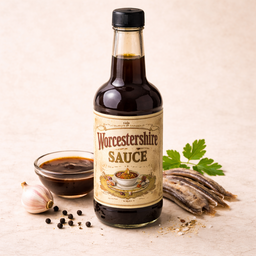
Worcestershire Sauce
Fermented condiment with deep umami and spiced sweet-sour notes
What is this ingredient?
Worcestershire sauce originated in Worcester, England in the 1830s and became known as a dark liquid condiment with a pronounced sweet-sour, salty and savory depth.
## The fifth taste
Umami is often called the fifth basic taste. In Worcestershire sauce, that savory impression mainly comes from fermented anchovies, vinegar, molasses, tamarind and spices. During fermentation, proteins break down into free amino acids, including glutamate, allowing a small amount of the sauce to add a lot of flavor.
## Fermentation and flavor building
Months of maturation give Worcestershire sauce layers of acidity, sweetness, saltiness, spice and savory depth. That makes it useful in meat marinades, tomato sauces, Caesar dressing, Bloody Mary, stews and savory vegetable dishes.
Note: classic Worcestershire sauce contains anchovies and is therefore not vegetarian. It is also relatively high in sodium, so use it mainly as a flavor accent in small amounts.
How does it taste?
Complex sweet-sour, salty and umami, with notes of fermentation, anchovy, tamarind, molasses and spices.
Pairs well with:
Pairs well with steakminced meattomato sauceCaesar saladBloody Marycheesemushrooms and stews.
Did you know...?
- According to the well-known story, Worcestershire sauce became popular by accident when a forgotten barrel of fermented sauce tasted surprisingly good after maturing.
- The original Lea & Perrins recipe from 1837 contains fermented anchovies, which means classic Worcestershire sauce is not vegetarian.
Nutritional Value & Energy
Per 100ml
Worcestershire Sauce provides energy thanks to natural nutrients .
Per 100g
Minerals
Vitamins
Omega-3 fatty acids
More nutrients
Trace Minerals
What's in a serving?
1 serving
Worcestershire sauce naturally contains potassium (540 mg per 100 g).
% of daily reference intake (DRI)
EU-approved nutrition claims
This ingredient contains nutrients for which EFSA-authorized health claims exist at nutrient level, not as an ingredient-specific claim for Worcestershire sauce.
Approved health claims (EU)
Potassium EU 432/2012
Potassium contributes to the maintenance of normal blood pressure
Contains 540mg/100g (threshold: ≥300mg/100g)
Potassium EU 432/2012
Potassium contributes to normal functioning of the nervous system
Contains 540mg/100g (threshold: ≥300mg/100g)
Potassium EU 432/2012
Potassium contributes to normal muscle function
Contains 540mg/100g (threshold: ≥300mg/100g)
Comparison
vsbanaan
Worcestershire sauce contains about 2× as much potassium per 100 g as banana, but it is normally used in much smaller amounts.
What's being researched?
Fermented ingredients and umami in Worcestershire sauce
Worcestershire sauce contains fermented anchovies, vinegar, tamarind, molasses and spices. Research on umami mainly describes how free glutamate and savory tastes influence the sensory experience of food; ingredient-specific research on Worcestershire sauce remains limited.
Supported by: [2] Kurihara K (2009) , [1] Yamaguchi S (2000)
Good Combinations (Synergy)
Combine worcestershire sauce smartly to enhance the effect:
Worcestershire Sauce 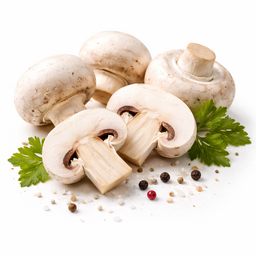 White Button Mushrooms
 Fermented anchovy enhances meat umami
Technical: Worcestershire sauce is fermented from anchovies containing high glutamate (umami). Beef contains inosinate and mushrooms guanylate — two nucleotides that synergistically amplify glutamate's umami effect (up to 8x). This triple umami stacking (glutamate + inosinate + guanylate) is the strongest flavor enhancement.
What does this mean for you? Add a splash of Worcestershire sauce to your beef-mushroom dish. The three umami sources amplify each other up to 8x — maximum flavor with minimum effort.
Worcestershire Sauce 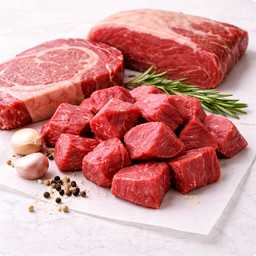 Beef
Beef Fermented anchovy enhances meat umami
Technical: Worcestershire sauce is fermented from anchovies containing high glutamate (umami). Beef contains inosinate and mushrooms guanylate — two nucleotides that synergistically amplify glutamate's umami effect (up to 8x). This triple umami stacking (glutamate + inosinate + guanylate) is the strongest flavor enhancement.
What does this mean for you? Add a splash of Worcestershire sauce to your beef-mushroom dish. The three umami sources amplify each other up to 8x — maximum flavor with minimum effort.
Worcestershire Sauce  Lemon
Lemon Fermented umami + vitamin C for flavor and iron absorption
Technical: Worcestershire sauce is a fermented product (anchovy, tamarind, vinegar, spices) rich in free glutamate, nucleotides (IMP from anchovy) and iron from anchovy (2mg/100ml). Lemon's vitamin C increases iron absorption from anchovy iron by 3-6x. Citric acid also enhances umami perception by lowering pH. The 18-month fermentation produces biogenic amines that act as natural flavor enhancers.
What does this mean for you? A few drops of Worcestershire sauce + lemon juice in dressings, marinades or Bloody Mary makes everything more intense. The lemon enhances umami and makes the iron from anchovies available.
Worcestershire Sauce  Olive Oil
 Umami emulsion for ultimate salad dressing
Technical: Worcestershire sauce contains tamarind acids and acetic acid that emulsify with olive oil into a stable vinaigrette. The umami compounds (glutamate + IMP nucleotides) are more evenly distributed in an oil emulsion, increasing flavor impact per drop. Olive oil's polyphenols protect omega-3 fatty acids from anchovy against oxidation. The combination offers: umami + acid + fat = the three flavor pillars of a good dressing.
What does this mean for you? Make a dressing of 3 parts olive oil + 1 part lemon + a few drops of Worcestershire sauce. This 'secret' dressing surpasses standard vinaigrette through the umami dimension.
Recipes with Worcestershire Sauce
Discover delicious recipes featuring worcestershire sauce:
 Caesar Salad with Chicken 25 min Classic Roman salad with crispy romaine and parmesan
  340 kcal
  32g protein 1 synergies
  In the Kitchen
Storage
Location:Pantry
Shelf life:3 jaar ongeopend, 1 jaar geopend (kamertemperatuur)
Store unopened at room temperature, away from direct sunlight. After opening, the sauce usually keeps well for a long time; close the bottle tightly and follow the label for refrigeration or room-temperature storage.
Preparation
Use small amounts in marinades, Caesar dressing, Bloody Mary, tomato sauce, stews and vegetable dishes. Add it early for an integrated savory background or at the end for a sharper sweet-sour accent.
Conversions
Substitutes
Smart preparation
1Use Worcestershire sauce as a concentrated umami accent in stews, burgers, gravy and marinades.
2Add a few drops to Bloody Mary or Caesar dressing for extra savory depth.
3Shake the bottle well before use; spices and thicker ingredients can settle at the bottom.
Why?
Shaking distributes the flavor more evenly, especially if the bottle has been standing for a long time.
Caution / Warnings
Worcestershire Sauce is very safe, but there are scientific considerations:
Fish Allergy Severe
Classic Worcestershire sauce contains anchovies, a fish ingredient that may be unsuitable for people with a fish allergy.
Advice:
Check the label and choose a vegetarian Worcestershire-style option without anchovies when you avoid fish.
Sodium-restricted diet Moderate
This sauce is high in sodium for a condiment, with almost 1 g sodium per 100 ml.
Advice:
Use small amounts, such as a few drops or a teaspoon, and taste before adding extra salt.
Traditional use
Other
Worcestershire sauce as British-Indian culinary heritage
Worcestershire sauce was developed in 1837 by Lea & Perrins in Worcester and is often linked to British interest in Indian spiced sauces from that period. It later became a staple condiment in British, American and international kitchens.
Summary
Worcestershire sauce is a concentrated fermented condiment that adds umami, sweet-sour depth and spice with just a few drops. Use it in marinades, dressings, tomato sauces and stews. Be mindful of its sodium content and the anchovies used in classic recipes.