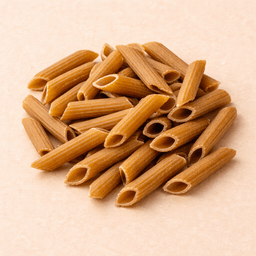
Whole wheat pasta
Fiber-rich whole wheat pasta with a firm, nutty bite
What is this ingredient?
Whole wheat pasta is made from whole wheat flour, retaining all parts of the grain kernel: bran, germ, and endosperm. This gives it a darker color, a firmer bite, and a nuttier flavor than white pasta.
## Whole grain and texture
Because the bran and germ remain present, whole wheat pasta contains more fiber and micronutrients than refined pasta. In this file, 100 g of dry product contains 8.2 g fiber and 14.6 g protein. Pasta’s compact structure also gives it a different bite from bread or loose grains: when cooked well, whole wheat pasta stays firm and works well with sauces based on tomato, olive oil, garlic, vegetables, legumes, or fish.
## Glycemic index as nutrition data
Whole wheat pasta has a GI range of about 45-50 in this file, compared with often higher values for white pasta. This is a nutritional measure of how quickly carbohydrates become available as glucose after a meal. The actual meal response always depends on portion size, cooking time, sauce, fats, protein, vegetables, and personal tolerance.
## Research context
Human nutrition studies have examined pasta because of the compact structure of its dough and the way starch becomes available during digestion. Whole grain products have also been widely studied in relation to fiber intake, meal composition, and dietary patterns. These studies describe associations and measured biomarkers, but they do not make whole wheat pasta a medical product.
## Practical use
Cook whole wheat pasta in plenty of water and start tasting from 8 minutes, because the bran layer can slightly extend cooking time. Combine it with a protein source such as chickpeas, chicken, salmon, or ricotta and with vegetables such as tomato, spinach, courgette, or bell pepper for a complete, flavorful meal.
How does it taste?
Nutty and full-flavored with a firm bite and earthy undertone.
Pairs well with:
Pairs well with pestoroasted vegetableswalnutsricottaand sage.
Did you know...?
- Whole wheat pasta has a nutty flavor because the wheat germ and bran remain intact.
- The first mention of pasta in Italy dates from 1154 in a Sicilian document.
Nutritional Value & Energy
Per 100g
Whole wheat pasta provides energy thanks to natural nutrients , buffered by fiber.
Per 100g
Minerals
Vitamins
Omega-3 fatty acids
More nutrients
B-Vitamins
Trace Minerals
What's in a serving?
1 serving (dry)
Whole wheat pasta naturally contains iron (3.6 mg per 100 g).
Whole wheat pasta naturally contains zinc (2.6 mg per 100 g).
Whole wheat pasta naturally contains magnesium (143 mg per 100 g).
Whole wheat pasta naturally contains potassium (300 mg per 100 g).
Whole wheat pasta naturally contains phosphorus (328 mg per 100 g).
Whole wheat pasta naturally contains selenium (63.2 mcg per 100 g).
Whole wheat pasta naturally contains folate (44 mcg per 100 g).
% of daily reference intake (DRI)
EU-approved nutrition claims
This ingredient contains nutrients for which EFSA-authorized health claims exist at nutrient level, not as an ingredient-specific claim for whole wheat pasta.
Approved health claims (EU)
Magnesium EU 432/2012
Magnesium contributes to normal muscle function
Contains 143mg/100g (threshold: ≥56.25mg/100g)
Magnesium EU 432/2012
Magnesium contributes to the reduction of tiredness and fatigue
Contains 143mg/100g (threshold: ≥56.25mg/100g)
Magnesium EU 432/2012
Magnesium contributes to normal functioning of the nervous system
Contains 143mg/100g (threshold: ≥56.25mg/100g)
Zinc EU 432/2012
Zinc contributes to the normal function of the immune system
Contains 2.6mg/100g (threshold: ≥1.5mg/100g)
Zinc EU 432/2012
Zinc contributes to the maintenance of normal skin
Contains 2.6mg/100g (threshold: ≥1.5mg/100g)
Iron EU 432/2012
Iron contributes to normal energy-yielding metabolism
Contains 3.6mg/100g (threshold: ≥2.1mg/100g)
Iron EU 432/2012
Iron contributes to the reduction of tiredness and fatigue
Contains 3.6mg/100g (threshold: ≥2.1mg/100g)
Potassium EU 432/2012
Potassium contributes to the maintenance of normal blood pressure
Contains 300mg/100g (threshold: ≥300mg/100g)
Folate EU 432/2012
Folate contributes to normal blood formation
Contains 44mcg/100g (threshold: ≥30mcg/100g)
Folate EU 432/2012
Folate contributes to normal amino acid synthesis
Contains 44mcg/100g (threshold: ≥30mcg/100g)
Folate EU 432/2012
Folate contributes to normal homocysteine metabolism
Contains 44mcg/100g (threshold: ≥30mcg/100g)
Folate EU 432/2012
Folate contributes to normal psychological function
Contains 44mcg/100g (threshold: ≥30mcg/100g)
Folate EU 432/2012
Folate contributes to the normal function of the immune system
Contains 44mcg/100g (threshold: ≥30mcg/100g)
Folate EU 432/2012
Folate has a role in the process of cell division
Contains 44mcg/100g (threshold: ≥30mcg/100g)
Folate EU 432/2012
Folate contributes to maternal tissue growth during pregnancy
Contains 44mcg/100g (threshold: ≥30mcg/100g)
Phosphorus EU 432/2012
Phosphorus contributes to normal energy-yielding metabolism
Contains 328mg/100g (threshold: ≥105mg/100g)
Phosphorus EU 432/2012
Phosphorus contributes to the normal function of cell membranes
Contains 328mg/100g (threshold: ≥105mg/100g)
Phosphorus EU 432/2012
Phosphorus contributes to the maintenance of normal bones
Contains 328mg/100g (threshold: ≥105mg/100g)
Phosphorus EU 432/2012
Phosphorus contributes to the maintenance of normal teeth
Contains 328mg/100g (threshold: ≥105mg/100g)
Magnesium EU 432/2012
Magnesium contributes to normal energy-yielding metabolism
Contains 143mg/100g (threshold: ≥56.25mg/100g)
Magnesium EU 432/2012
Magnesium contributes to electrolyte balance
Contains 143mg/100g (threshold: ≥56.25mg/100g)
Magnesium EU 432/2012
Magnesium contributes to normal protein synthesis
Contains 143mg/100g (threshold: ≥56.25mg/100g)
Magnesium EU 432/2012
Magnesium contributes to normal psychological function
Contains 143mg/100g (threshold: ≥56.25mg/100g)
Magnesium EU 432/2012
Magnesium contributes to the maintenance of normal bones
Contains 143mg/100g (threshold: ≥56.25mg/100g)
Magnesium EU 432/2012
Magnesium contributes to the maintenance of normal teeth
Contains 143mg/100g (threshold: ≥56.25mg/100g)
Magnesium EU 432/2012
Magnesium has a role in the process of cell division
Contains 143mg/100g (threshold: ≥56.25mg/100g)
Iron EU 432/2012
Iron contributes to normal cognitive function
Contains 3.6mg/100g (threshold: ≥2.1mg/100g)
Iron EU 432/2012
Iron contributes to normal formation of red blood cells and haemoglobin
Contains 3.6mg/100g (threshold: ≥2.1mg/100g)
Iron EU 432/2012
Iron contributes to normal oxygen transport in the body
Contains 3.6mg/100g (threshold: ≥2.1mg/100g)
Iron EU 432/2012
Iron contributes to the normal function of the immune system
Contains 3.6mg/100g (threshold: ≥2.1mg/100g)
Iron EU 432/2012
Iron has a role in the process of cell division
Contains 3.6mg/100g (threshold: ≥2.1mg/100g)
Zinc EU 432/2012
Zinc contributes to normal acid-base metabolism
Contains 2.6mg/100g (threshold: ≥1.5mg/100g)
Zinc EU 432/2012
Zinc contributes to normal carbohydrate metabolism
Contains 2.6mg/100g (threshold: ≥1.5mg/100g)
Zinc EU 432/2012
Zinc contributes to normal cognitive function
Contains 2.6mg/100g (threshold: ≥1.5mg/100g)
Zinc EU 432/2012
Zinc contributes to normal DNA synthesis
Contains 2.6mg/100g (threshold: ≥1.5mg/100g)
Zinc EU 432/2012
Zinc contributes to normal fertility and reproduction
Contains 2.6mg/100g (threshold: ≥1.5mg/100g)
Zinc EU 432/2012
Zinc contributes to normal macronutrient metabolism
Contains 2.6mg/100g (threshold: ≥1.5mg/100g)
Zinc EU 432/2012
Zinc contributes to normal metabolism of fatty acids
Contains 2.6mg/100g (threshold: ≥1.5mg/100g)
Zinc EU 432/2012
Zinc contributes to normal metabolism of vitamin A
Contains 2.6mg/100g (threshold: ≥1.5mg/100g)
Zinc EU 432/2012
Zinc contributes to normal protein synthesis
Contains 2.6mg/100g (threshold: ≥1.5mg/100g)
Zinc EU 432/2012
Zinc contributes to the maintenance of normal bones
Contains 2.6mg/100g (threshold: ≥1.5mg/100g)
Zinc EU 432/2012
Zinc contributes to the maintenance of normal hair
Contains 2.6mg/100g (threshold: ≥1.5mg/100g)
Zinc EU 432/2012
Zinc contributes to the maintenance of normal nails
Contains 2.6mg/100g (threshold: ≥1.5mg/100g)
Zinc EU 432/2012
Zinc contributes to the maintenance of normal testosterone levels in the blood
Contains 2.6mg/100g (threshold: ≥1.5mg/100g)
Zinc EU 432/2012
Zinc contributes to the maintenance of normal vision
Contains 2.6mg/100g (threshold: ≥1.5mg/100g)
Zinc EU 432/2012
Zinc contributes to the protection of cells from oxidative stress
Contains 2.6mg/100g (threshold: ≥1.5mg/100g)
Zinc EU 432/2012
Zinc has a role in the process of cell division
Contains 2.6mg/100g (threshold: ≥1.5mg/100g)
Selenium EU 432/2012
Selenium contributes to the maintenance of normal hair
Contains 63.2mcg/100g (threshold: ≥8.25mcg/100g)
Selenium EU 432/2012
Selenium contributes to the maintenance of normal nails
Contains 63.2mcg/100g (threshold: ≥8.25mcg/100g)
Selenium EU 432/2012
Selenium contributes to the normal function of the immune system
Contains 63.2mcg/100g (threshold: ≥8.25mcg/100g)
Selenium EU 432/2012
Selenium contributes to normal thyroid function
Contains 63.2mcg/100g (threshold: ≥8.25mcg/100g)
Selenium EU 432/2012
Selenium contributes to normal spermatogenesis
Contains 63.2mcg/100g (threshold: ≥8.25mcg/100g)
Selenium EU 432/2012
Selenium contributes to the protection of cells from oxidative stress
Contains 63.2mcg/100g (threshold: ≥8.25mcg/100g)
Potassium EU 432/2012
Potassium contributes to normal functioning of the nervous system
Contains 300mg/100g (threshold: ≥300mg/100g)
Potassium EU 432/2012
Potassium contributes to normal muscle function
Contains 300mg/100g (threshold: ≥300mg/100g)
What's being researched?
Whole grain pasta and glycemic response
The effects of whole grain pasta compared with refined pasta are being studied in human nutrition research. Pasta’s compact structure and higher fiber content are often discussed as factors that can influence measured responses after a meal.
Supported by: [1] Jenkins (1983) , [3] Scazzina (2019) , [2] Kristensen (2016)
Good Combinations (Synergy)
Combine whole wheat pasta smartly to enhance the effect:
Whole wheat pasta  Broccoli
 Vitamin C increases iron absorption from whole wheat by 6x
Technical: Whole wheat pasta contains 3.6mg non-heme iron per 100g (dry), but also phytate that inhibits iron absorption. Broccoli provides 89mg vitamin C per 100g that reduces Fe³⁺ to Fe²⁺ (the bioavailable form) and counteracts phytate inhibition. Studies show 50mg vitamin C (≈55g broccoli) increases iron absorption from grains by 400-600%. Broccoli also contains sulforaphane, a much-studied bioactive compound.
What does this mean for you? Whole wheat pasta with broccoli is an ideal iron combination — the vitamin C from broccoli makes the iron from pasta available that would otherwise be lost to phytate in the grain.
Whole wheat pasta  Olive Oil
 Olive oil increases absorption of vitamin E and carotenoids from whole wheat
Dietary fat improves fat-soluble nutrient absorption via micelle formation (PMID: 15570047)
Technical: Whole wheat contains alpha-tocopherol (1.4mg/100g) and lutein (220μg/100g), both fat-soluble. Oleic acid from olive oil forms mixed micelles making fat-soluble nutrients up to 3x more bioavailable. Additionally, both contain phenolic compounds (hydroxytyrosol from olive oil, ferulic acid from wheat) that work synergistically as antioxidants.
What does this mean for you? Whole wheat pasta with olive oil is more than a flavor combination — the fat ensures you actually absorb the fat-soluble vitamins from the pasta. Italian cuisine has known this for centuries.
Whole wheat pasta  Tomato
 Selenium + lycopene for dual antioxidant support
Technical: Whole wheat pasta contains 63ug selenium per 100g (115% RDA), a trace element essential for glutathione peroxidase — the most important intracellular antioxidant enzyme. Tomato provides lycopene (3mg/100g cooked), a carotenoid that neutralizes free radicals. Together they offer intracellular (selenium/glutathione) + extracellular (lycopene) antioxidant support.
What does this mean for you? Pasta pomodoro with whole wheat pasta is more than comfort food — it delivers dual antioxidant support. The selenium in the wheat + the lycopene in the tomato work complementarily.
 In the Kitchen
Storage
Location:Pantry
Shelf life:12-24 maanden (droog)
Store dry whole wheat pasta in an airtight container in a cool, dry place. Cooked pasta usually keeps for 3-5 days in the fridge and 2-3 months in the freezer.
Preparation
Cook in plenty of salted water (about 1 l per 100 g), 9-12 minutes for al dente. Taste regularly from 8 minutes and save some cooking water to bind the sauce.
Conversions
Substitutes
Smart preparation
1Cook whole wheat pasta 1-2 minutes longer than regular pasta.
Why?
The bran layer makes whole wheat pasta slightly firmer and slower to cook.
2Use extra cooking water, because whole wheat pasta can foam a little more.
3Save some cooking water; the starch helps the sauce cling better.
Caution / Warnings
Whole wheat pasta is very safe, but there are scientific considerations:
Gluten intolerance / celiac disease Severe
Whole wheat pasta contains wheat gluten and is therefore not suitable for people with celiac disease or a medical need to avoid gluten completely.
Advice:
Avoid with celiac disease. Choose a gluten-free alternative such as quinoa, brown rice, corn, buckwheat, or lentil pasta, and always check the label for cross-contamination.
Phytic acid and mineral absorption Mild
Whole grain products contain phytic acid, a plant compound that can bind minerals such as iron, zinc, and calcium.
Advice:
For most varied eating patterns, this is not a problem. Pair with vitamin C-containing vegetables or fruit, such as tomato or bell pepper, when you want a more mineral-rich meal.
IBS with FODMAP sensitivity Moderate
Whole wheat contains fructans, a FODMAP group that may cause abdominal discomfort, gas, or bloating in some people.
Advice:
Test your personal tolerance with a small portion and consider the whole meal. Some people tolerate pasta better than bread because of its compact structure.
Summary
Whole wheat pasta keeps the bran and germ of wheat, making it fiber-rich (8.2 g/100 g dry) with a firm, nutty bite. Its compact structure and GI range of about 45-50 make it an interesting base for meals with vegetables, legumes, fish, chicken, or cheese.