Shatavari
Ayurvedic root with a gentle, earthy taste
What is this ingredient?
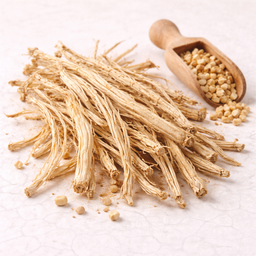
Shatavari (Asparagus racemosus) is a root from the asparagus family that grows in India, Nepal and Sri Lanka. Its name comes from Sanskrit and is often poetically translated as “she who has a hundred husbands”, referring to the plant’s place in Ayurvedic traditions.
In the kitchen, the dried root powder is used most often. The taste is mildly bitter, slightly sweet and earthy, so shatavari is commonly mixed with warm milk, plant milk, ghee, honey, cinnamon or cardamom. In modern recipes, it also fits into oatmeal, smoothies and creamy drinks.
The root naturally contains fibre, starchy carbohydrates and several plant compounds, including steroidal saponins known as shatavarins. Researchers study Asparagus racemosus in both traditional botanical contexts and modern food and herbal science. Available studies cover composition, history of use, digestion, postpartum applications and menopause-related questions, but public product text should remain careful: shatavari is not a medicine and does not replace personal medical advice.
In practical terms, shatavari is a subtle powdered root, especially interesting for its culinary role in Ayurvedic milk drinks, its gentle earthy taste and its rich cultural history.
How does it taste?
Mildly bitter with a slightly sweet, earthy root-like flavor.
Pairs well with:
Pairs well with honeywarm milkgheecinnamon and cardamom.
Did you know...?
- Shatavari means 'she who has a hundred husbands' in Sanskrit.
- Shatavari belongs to the asparagus family; mainly the roots are dried and ground.
Nutritional Value & Energy
Per 100g
Shatavari provides energy thanks to natural nutrients , buffered by fiber.
Per 100g
Minerals
Vitamins
More nutrients
Trace Minerals
EU-approved nutrition claims
There are currently no EFSA-authorized health claims specific to shatavari. Various applications for herbs and spices have been submitted but not yet assessed (botanical 'on hold' list).
What's being researched?
Shatavari in Ayurvedic traditions and modern studies
Shatavari is studied through its long history of use in Ayurveda and through modern clinical and botanical research questions. The available literature is growing, but public product text is best kept descriptive and careful.
Supported by: [1] Pandey (2005) , [6] Rao RV (2024) , [7] Sharma A (2024) , [8] Mahajan S (2024)
Shatavari and plant compounds
Saponins and other plant compounds in shatavari are studied in preclinical models. Such results are useful for understanding composition, but they are not the same as an authorized health claim.
Supported by: [4] Singh N (2023) , [1] Pandey (2005)
Good Combinations (Synergy)
Combine shatavari smartly to enhance the effect:
Shatavari 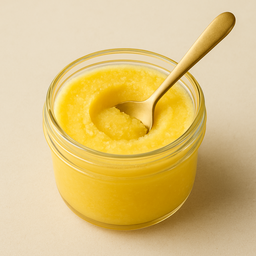 Ghee
Ghee Traditional Ayurvedic combination for hormonal balance
Technical: Shatavari (Asparagus racemosus) contains steroidal saponins (shatavarins) that modulate estrogen receptors and support hormonal balance as an adaptogen. These saponins are fat-soluble. Milk/ghee provides fats increasing absorption. This is the principle of Ayurvedic 'anupana' — the carrier system.
What does this mean for you? Take shatavari with warm milk or ghee, as in Ayurvedic tradition. The milk fat helps your body better absorb the active compounds.
Shatavari 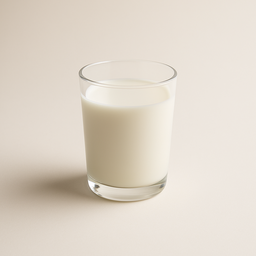 Milk
Milk Traditional Ayurvedic combination for hormonal balance
Technical: Shatavari (Asparagus racemosus) contains steroidal saponins (shatavarins) that modulate estrogen receptors and support hormonal balance as an adaptogen. These saponins are fat-soluble. Milk/ghee provides fats increasing absorption. This is the principle of Ayurvedic 'anupana' — the carrier system.
What does this mean for you? Take shatavari with warm milk or ghee, as in Ayurvedic tradition. The milk fat helps your body better absorb the active compounds.
Shatavari 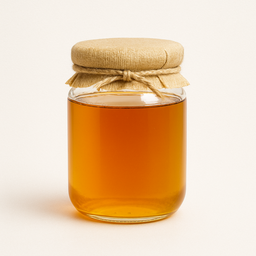 Honey
Honey Adaptogenic shatavari + honey as anupana (carrier) per Ayurveda
Technical: Shatavari (Asparagus racemosus) contains shatavaroside and racemosol — steroidal saponins that modulate estrogen receptors and stimulate prolactin. In Ayurveda, honey is used as 'anupana' (carrier) that increases bioavailability of herbal preparations. Honey's hygroscopic (moisture-attracting) properties help dissolve and transport shatavari's saponins. Studies show shatavari increases lactation milk by 30-50%.
What does this mean for you? Mix shatavari powder with raw honey and take it in the morning. The honey makes it easy to take and enhances absorption — an ancient Ayurvedic protocol.
Shatavari  Coconut Milk
 MCT fats enhance absorption of fat-soluble shatavari saponins
Technical: Shatavari's steroidal saponins (shatavarin I-IV) are amphiphilic — partially fat-, partially water-soluble. Coconut milk's MCTs facilitate micelle formation that improves intestinal absorption by 2-3x. In Ayurveda, shatavari is traditionally taken with warm milk (ksheerapaka). Coconut milk offers the same fat medium with MCTs that are absorbed faster than long-chain fats. The combination is ideal for plant-based diet.
What does this mean for you? Make a shatavari-coconut milk latte: warm coconut milk + shatavari powder + pinch of cardamom. This is the vegan version of the Ayurvedic shatavari-milk recipe.
Recipes with Shatavari
Discover delicious recipes featuring shatavari:
 Shatavari Moon Milk 10 min Warm Ayurvedic moon milk with shatavari, ashwagandha and gentle spices
  85 kcal
  2g protein 1 synergies
  In the Kitchen
Storage
Location:Pantry
Shelf life:18-24 maanden (poeder), 2-3 jaar (capsules)
Store airtight, cool and dark. The powder absorbs moisture easily, so close the package immediately after use.
Preparation
Mix 1/4 to 1 teaspoon of powder into warm milk, plant milk, oatmeal or a smoothie. The earthy taste pairs well with honey, ghee, cinnamon and cardamom. Do not add it to vigorously boiling liquid if you want to preserve the delicate aroma.
Conversions
Substitutes
Smart preparation
1Mix shatavari powder into warm milk, plant milk, oatmeal or a smoothie.
Why?
The mild, slightly bitter taste pairs well with creamy drinks and warm spices.
2Start with a quarter teaspoon to get used to the taste, then build up gradually.
3Store shatavari powder dry, cool and away from light.
Caution / Warnings
Shatavari is very safe, but there are scientific considerations:
Oestrogen-sensitive conditions Severe
Use caution with breast cancer, uterine cancer, endometriosis or other oestrogen-sensitive conditions, because shatavari contains plant compounds that may resemble oestrogen-receptor activity.
Advice:
Use concentrated extracts only after consulting a doctor or dietitian.
Pregnancy Moderate
Culinary amounts in drinks or food differ from concentrated supplement forms. During pregnancy, extra caution is sensible.
Advice:
Discuss the use of concentrated shatavari products during pregnancy with a doctor or midwife.
Diuretics Mild
In herbal traditions, shatavari is sometimes combined with water-balancing herbs. With medication that affects fluid balance, caution is sensible.
Advice:
Use concentrated extracts only in consultation with a healthcare professional if you take diuretics.
Traditional use
Ayurveda
Queen of herbs in Ayurveda
Shatavari ('she who possesses a hundred husbands') has a long cultural place in Ayurveda as a nourishing root in warm drinks and ritual preparations, especially in contexts around women and life stages.
Summary
Shatavari is an Ayurvedic root with a mild, earthy taste, often used in warm milk drinks, smoothies or oatmeal. The root contains fibre and natural saponins and has a long cultural history in South Asia. During pregnancy, breastfeeding, medication use or oestrogen-sensitive conditions, professional advice is sensible, especially with concentrated extracts.